Hello folks,
This is the first episode of Weekly Maloche. I chose the title because it will fit the topics and is also one of my favourite German words. Maloche means hard work in German and is often used by blue-collar workers when they talk about their work. Also, I am not a good writer (as of now), but I hope to make it a habit this year and publish at least once per month. So writing is my Maloche :)
Cheers Felix
Two quick questions before we start.
How much do you think the average American household spent on services (healthcare, housing, education, utilities, etc.) last year?
And second, what about in 1984—what do you think a household spent on services back then?
Got two numbers in mind?

And the answer is….
In 2024, the average American household spent about $47,000 on services. In 1984, they spent $9,600. But when we adjust that 1984 figure for inflation, it’s equivalent to roughly $29,000 in today’s dollars.
So we’re now paying about 60% more in real terms on services than we did forty years ago.
When I first saw that, I wasn’t surprised—we hear constantly about healthcare costs exploding and tuition reaching all-time highs. But here’s what’s wild: in 1984, services were only 48% of your budget. Today they’re over 60%.
The share of your income going to services jumped by 12 percentage points while goods (TVs, clothes, appliances) shrank from half your spending to barely a third.
How is this possible? In the last 40 years, we’ve gotten dramatically better at making stuff. The first cell phones cost $10,000. Now you can buy one a hundred times better for a hundredth of the price. Similar story for cars, appliances, and clothing. Productivity gains crushed the cost of goods.
But services? Not so much. A plumber can’t fix 50 pipes at once; they can only do one at a time. That hasn’t changed since 1984. Or ever.
But why am I telling you this?
How I stumbled into a 60-year-old economic theory
After I left my last startup job, I was looking into potential new ventures. I kept coming back to the trades (so plumbing, electricians, etc.). I also kept seeing videos of Silicon Valley folks like Jensen talking about how everyone should become a plumber or electrician and get rich. Okay then, how can I, as a business major with barely enough electrical skills to install a lamp on the ceiling, become an electrician? Do a 3-year apprenticeship in Germany? Probably not.
Then I stumbled on something called a Search Fund. Basically, a version of ETA (Entrepreneurship through Acquisition) where you bring together a group of investors who back you to buy an existing business and become CEO. While looking at these options, I dug deeper into the trades and other service businesses, thinking about how I could take AI to improve them, to be a better business, improve margins, and improve cash flows. And then it appeared in a Claude answer…
Baumol’s Cost Disease.
I had asked something like “why are trades so hard to scale” or “how can AI improve service businesses”, expecting the usual answers about scheduling software, CRM systems, maybe some computer vision for diagnostics. Instead, Claude told me about a 1960s economist who studied symphony orchestras.
I thought, what the hell do orchestras have to do with plumbers?
Turns out, everything.
The Cost Disease
Baumol’s thesis is pretty simple: why do orchestras keep getting more expensive? A string quartet plays Beethoven exactly the same way they did 100 years ago. Four musicians, four instruments, same time. No productivity gains are possible. But those musicians could quit and go work at a factory, or today at Google. To keep them playing, you have to match wages from the productive economy. Wages rise, output stays the same, so ticket prices rise. Forever until eternity.
He called it the Cost Disease. Sectors that can’t improve productivity must still compete for labour with sectors that can.
His paper was published 60 years ago, so we have enough data to see if his predictions have turned out to be true. Let’s look at prices for services and high productivity growth sectors like manufacturing. Take this graph, for example. Prices in sectors like healthcare, education, and other labour-intensive sectors have increased significantly. Some even doubled or tripled. While prices for goods like cars, computer software, or toys have only increased by a few per cent or slashed prices in half or even decreased.
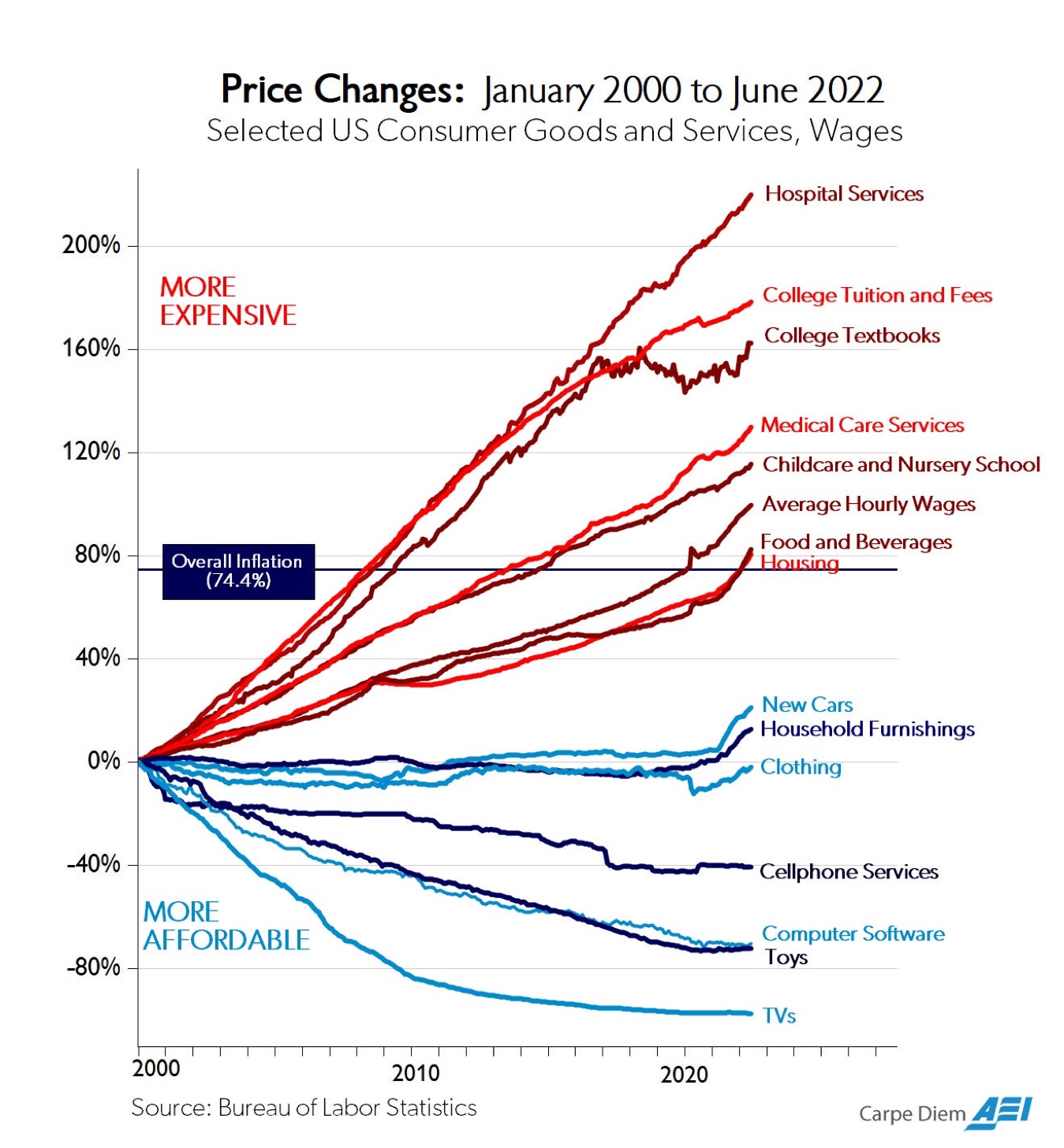
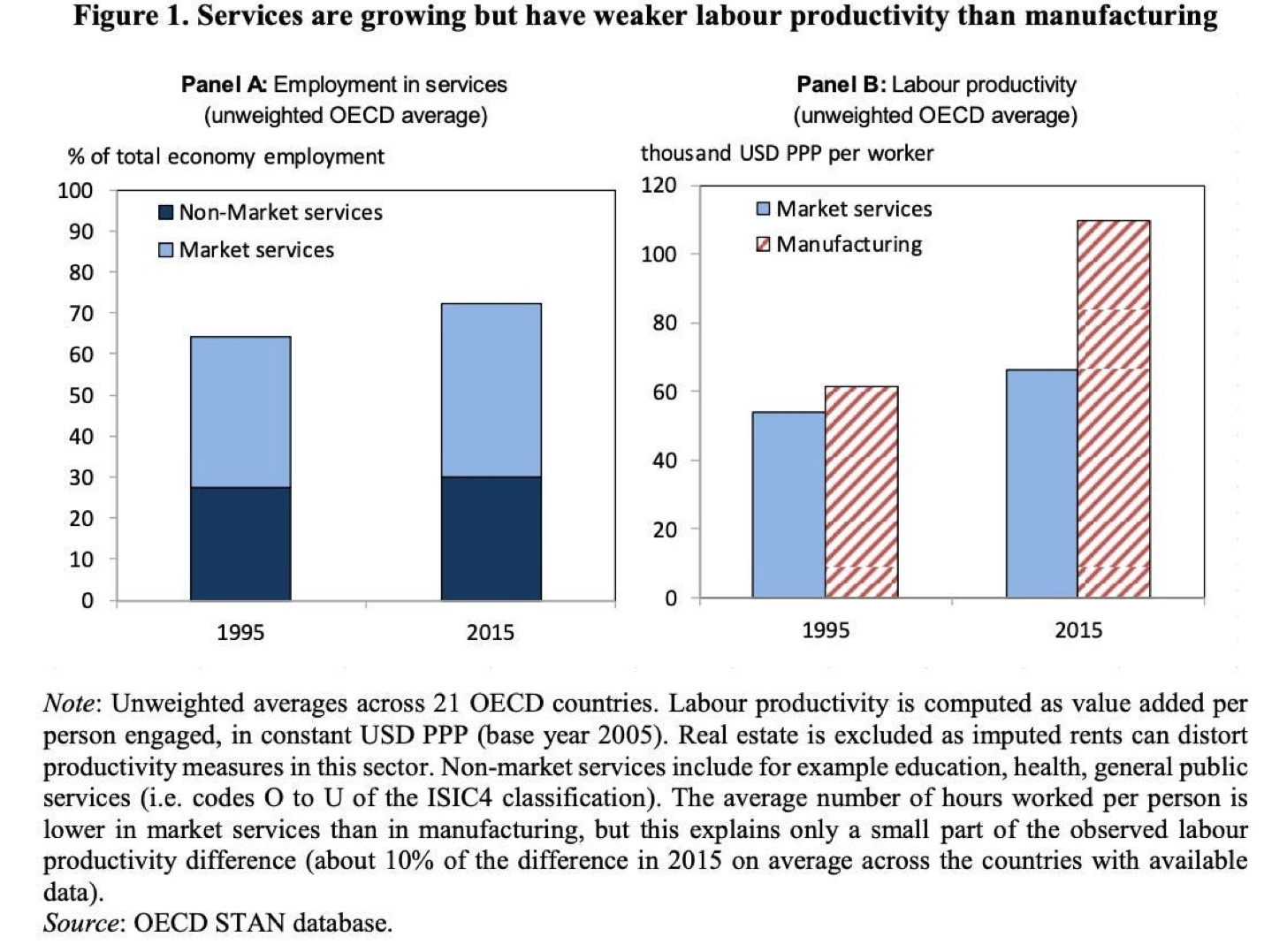
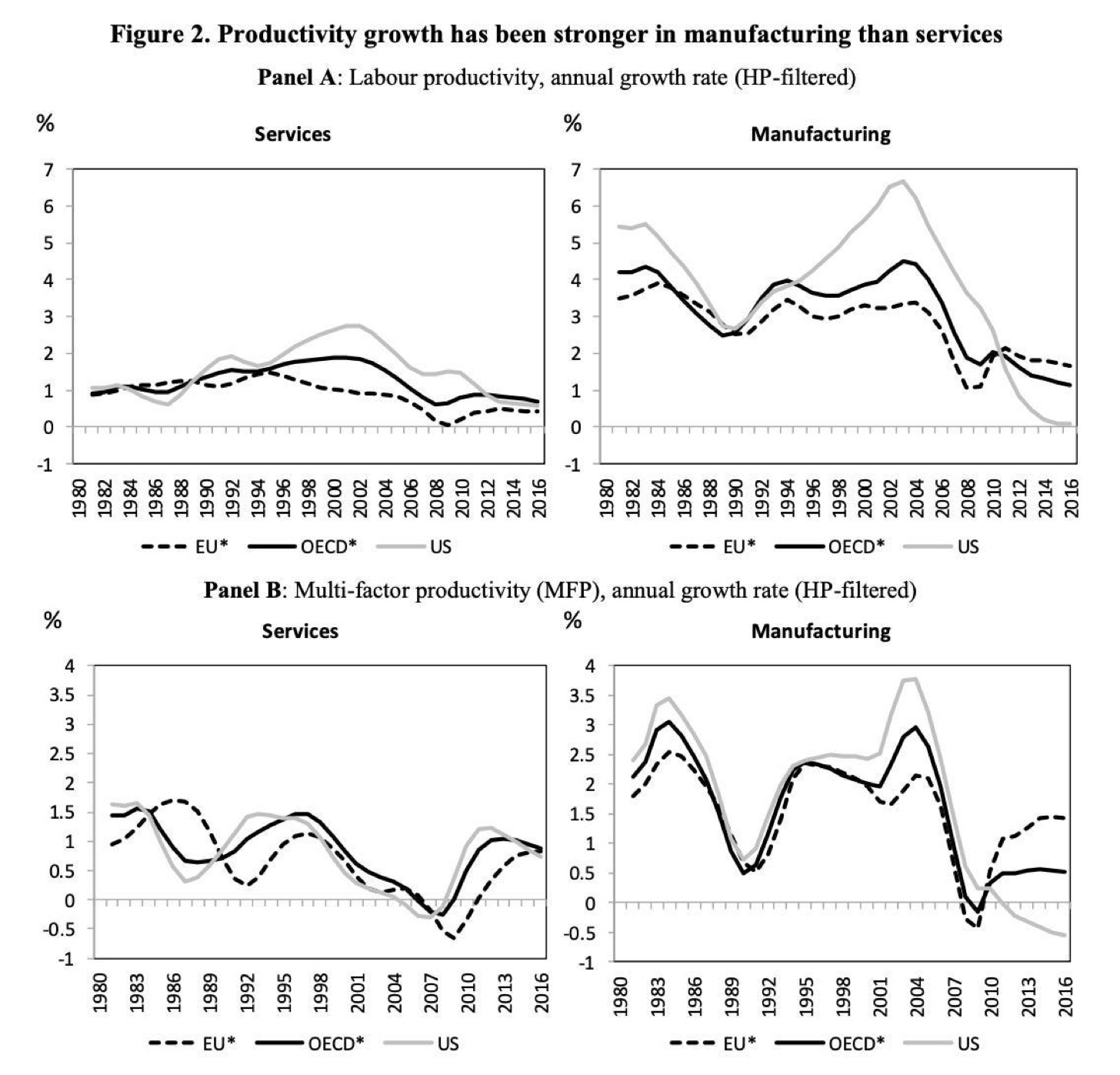
So prices have increased significantly for labour-intensive sectors. But what about productivity? Turns out he is generally right about this as well, but it is a bit more nuanced. Labour productivity in services has increased in the past, but not at all close to the level of manufacturing.
Why some services escaped, and others didn’t
Interestingly, some services have had strong productivity growth in the past decades, but these are mostly knowledge-intensive services like ICT, finance and professional services. But why can it happen for some and not for all? To understand this, we need to look at the characteristics of different services. Services can be split into a 2 by 2 matrix based on whether they can be standardised and whether they have to be delivered in person.
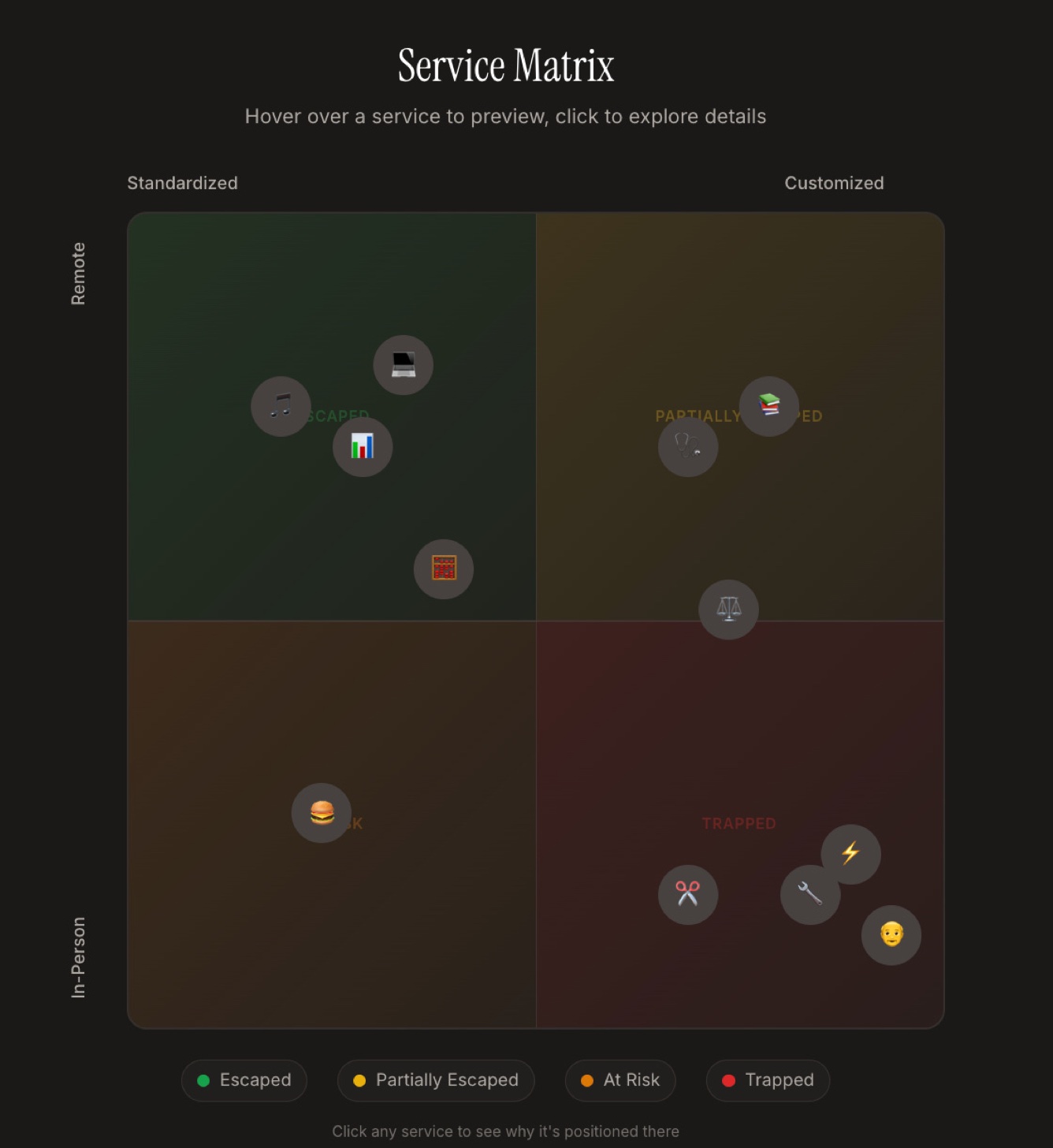
Click here to play around with this interactive Matrix, which I built using Lovable.
Depending on which field of the matrix a specific service is located in, productivity growth faces different hurdles, which are dictated by current technology. The hurdles can be divided into three main buckets.
Cognitive & physical difficulty
Cognitive and physical difficulty describes whether a service requires significant human judgment or human motoric skills that a machine cannot replicate reliably or accurately. This difficulty is on a spectrum. For example, electrical troubleshooting or rewiring a house is pretty difficult, because it needs an experienced electrician with lots of knowledge and skills and also the fine motor skills of a human to get the job done. A diagnosis by a doctor is still pretty difficult, but it can be automated to an extent with AI and machine learning algorithms. But ultimately, you still need a highly qualified human in most cases. A case that is less cognitively and physically demanding is the work of a tax accountant. Software startups like TurboTax or Taxfix have figured out the logic and trained algorithms or AI models to prepare tax returns for individuals. All the user needs to do is input their data, and voilà, done—here is your tax return.
Spatial transaction costs
Does the service provider need to be where the customer is, or can it be done remotely or even without a human as the service provider? A plumber cannot fix your pipes remotely or just by pushing a button in fancy software. This influences how many customers you can serve. A plumber can do one or two big jobs a day and maybe squeeze in one small one in between. Travel time between job sites reduces the plumber’s effective working time. Remote IT support or telehealth consultations do not have this problem; they can jump on a call when the customer needs them and serve many more customers in a day.
Competitive pressure
Many services operate in small local markets with few providers. A certain area has only so many plumbing jobs, and perhaps a few dozen plumbers. Therefore, plumbers have little to no incentive to innovate, and customers have limited alternatives. On the other hand, a SaaS that solves a global problem can go global from day one. They have hundreds of thousands to millions of potential customers, face global competition and need to innovate regularly to keep their customers happy and not switch to the competition.
The trap that feeds itself
The first two hurdles are baked into the nature of the service itself. But the third one is different—it’s self-reinforcing. Low competition means no incentive to innovate. No innovation means the disease persists. And the disease keeps competition local. Round and round. This is why Baumol’s cost disease has looked permanent for some sectors. The trap feeds itself.
Low competition → no incentive to innovate → disease persists → keeps competition local
But permanent is a strong word.
What Baumol got wrong
Baumol got the diagnosis right. But like many economic models, he left something out to make the math work: the innovative spirit of the human race. He assumed things would be done the same way until eternity. Which is obviously not the case. At least for some services. All you need is a few technological breakthroughs, and his thesis does not hold anymore.
Let’s take his own example, the performance of Beethoven’s Symphony No. 5. Yes, if it could only be performed by a group of musicians, then his thesis holds. But what about recordings, music tapes, CDs, the Walkman and Spotify? If you want to be super granular, you could argue that it is not the same service. But what do we want? Is it to watch a group of humans play a few instruments, or is it a thousand songs in your pocket? I would say it is the latter. I personally think Baumol confused the work with the outcome. To fix the service’s productivity problem, we need to focus on the outcome and figure out how we can provide it at the lowest possible cost.
And there are more examples: telemedicine, tax software, remote IT support, and online education. These weren’t impossible problems. They were problems waiting for the right technology to route around the constraint.
The hardest cases
But here’s the harder question: what about services stuck in the bottom-left quadrant of our matrix? Plumbing. Elder care. Electrical work. These face all three impediments at once—cognitively complex, physically required on-site, and trapped in local markets. The Spotify playbook doesn’t obviously apply. You can’t stream a pipe repair.
How do we get to an outcome that customers want in a more productive way? How can we navigate around the Baumol cost disease for these services? Obviously, there are many different approaches that have been tried and are currently being tried by startups across the globe. You have vertical integration, robots, or cases like Tesla and Waymo, where you turn labour (the driver) into capital (self-driving car). The insight is that breaking Baumol’s trap doesn’t always mean making the worker faster; sometimes it means eliminating the need for the worker in certain contexts or taking parts of the job away from them so they can focus on what’s actually valuable and productive.
Why this matters
We talked about the “how.” But why should we care? What’s actually at stake?
Currently, the stalling productivity in the service sector creates a -0.3% drag on total productivity per year. I repeat: PER YEAR! Over a generation, that’s trillions in foregone GDP. It’s the difference between wages growing and wages stagnating. And because services are now 60% of spending (callback to our fun quiz), the drag is getting heavier as service sectors grow.
All this is not abstract economics. It is one big reason why healthcare feels unaffordable, why childcare costs crush families, and why calling a plumber is eye-wateringly expensive. These aren’t moral failures or corporate greed (mostly)—they’re structural consequences of Baumol’s disease running unchecked for decades.
What this Substack is about
I think services, especially the trades, are where the interesting problems are. Lots broken, massive upside if you find the right angle. That’s not just an opinion; it’s a bet I’m making. I work at Smalt, where we’re building an AI backoffice and growth engine for Handwerker. Every day, we are looking at what’s keeping these businesses from scaling and what might finally break the trap.
This Substack is where I’ll share what I’m learning. Case studies of companies routing around Baumol. Frameworks for thinking about which services can be fixed and which are truly stuck. And the occasional rant about the system, the regulations, the lack of great tools, or the market dynamics that trap skilled tradespeople and service providers.
Weekly Maloche: finding cures for Baumol’s disease.